The inputs above will be hidden when the program finally gets launched. Currently, I am not hiding them even when you close the calculator. The purpose of the inputs is to help in debugging. This allows you to enter simple code on the calculator screen but the program translates the input to javascript math. Give it a try and see if you notice any obvious problems or have suggestions for improvements.
The javascript math object methods used for this calculator are not accurate for very large or very small numbers. In particular, the trigonometric functions may yield very small answers that should actually be zero or very large answers that should be infinite. This typically occurs at 90° or pi/2 intervals.
DO NOT USE WHERE HIGH PRECISION IS REQUIRED. USE AT YOUR OWN RISK.
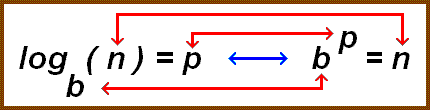
Using the expression below, one can write a logarithmic equation in exponential form and visa versa.
For example: log4( 64 ) = 3 is 4 3 = 64 in exponential form. If you have trouble making the conversion, remember logs are exponents. Note how the log of a number happens to be the exponent in exponential form. The bases should be obvious, which only leaves one empty postion for n.
The following table listing the properties of logarithms should enable you to do most calculations involving logarithms. Logarithms are also very helpful in solving exponential functions.
Logarithms of base 10 are called common logarithms and are generally denoted simply as the log of a number. Example: log(10) = 1.
Logarithms of base e are called natural logarithms and are generally denoted simply as the ln of a number. Example: ln(e) = 1.
Unfortunately, many logaritmic problems have bases other than 10 or e. Since log and ln are typically available on most calculators it is most fortunate that there exists a change of base formula.
loga( n ) = logb( n ) / logb( a )
Simply take the log or ln of a number and divide it by the log or ln of the old base. Be consistent, either use log or ln but don't mix them.