Complex Numbers Help |

|
Complex numbers are numbers that have a real part and an imaginary part. The imaginary part is typically designated with an i, where i is defined as the square root of negative one, √ -1 . In certain professions, such as electrical engineering, i is used to represent current, so electrical engineers generally use j to represent an imaginary number.
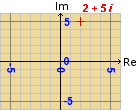
If z is a complex number, it can be written as: z = x + yi, where x = Re(z) and y = Im(z). Graphically, a complex number can be shown using a 2-dimensional, x-y graph with the x-axis being the real axis and the y-axis being the imaginary axis. A complex number can be shown as a specific point. For example, the complex number 2 + 5i is 2 units to the right of the y-axis and 5 units above the x-axis, as shown below:
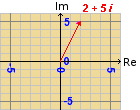
 However, complex numbers can also be shown as position vectors. The complex number, 2 + 5i shown as a position vector would appear as shown below:
 Complex numbers can be added, subtracted, multiplied and divided, plus they can be conjugated. Before we get into complex number operations, let's focus on i.
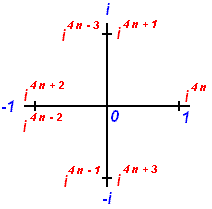
The various powers of i can all be expressed as 1, i, -1 or - i. If the exponent of i is a multiple of 4, such as i 4, i 8 or i 24 ⇒ i 4n = 1 If the exponent of i has a remainder of 1 after dividing by 4, such as i 5, i 9 or i 25 ⇒ i 4n+1 = i If the exponent of i has a remainder of 2 after dividing by 4, such as i 6, i 10 or i 18 ⇒ i 4n+2 = -1 If the exponent of i has a remainder of 3 after dividing by 4, such as i 7, i 11 or i 23 ⇒ i 4n+3 = -i Note that n can be any real integer, positive, negative or zero. You may also have noted that any even exponent of i that is not divisible by 4 will always equal -1. Addition and subtraction of complex numbers is easy, if you just remember that: • You can only add or subtract real numbers from real numbers and Simply gather all the real terms and perform your addition or subtraction and then gather all the imaginary terms and perform your addition or subtraction. The result will be the sum or difference of the real terms plus the sum or difference of the imaginary terms times i.
Multiplication of complex numbers is fairly straight forward if you treat the complex numbers as binomials. You can either use FOIL or generic rectangles to perform the multiplication. Once that is complete you must also simplify the imaginary terms, if possible.
You may wonder why and what is conjugation. Conjugation of a complex number is simply changing the sign of the imaginary term. Example 4, above, is an example of one complex number being multiplied times its complex conjugate. As you can see the result was purely real. This always happens when you multiply a complex number times its complex conjugate.
The reason why conjugation is covered before covering division of complex numbers is because you need to do conjugation in order to perform division. In order to divide two complex numbers you must first multiply the numerator and the denominator by the complex conjugate of the denominator. The result of this multiplication will leave you with a real number in the denominator, which greatly simplifies the overall computation.
Division of complex numbers is by far the most difficult of the complex number operations but is still quite manageable if you follow the rules. |