Advanced Integration Techniques Help |


|
Sometimes you will find that it is virtually impossible to integrate a function because of its complexity. In this section you will be provided with four advanced techniques of integration.
• Integration by substitution. The basic idea with the substitution technique is to simplify the given integral. Given an integral `int f(x) dx`, come up with a substitution `u = u(x)`. Find `x = x(u)` and `dx = x'(u) du`. Substitute back into the original function: `int f(x) dx = int f(x(u))x'(u) du` If the new integral isn't any easier than the original one, try another substitution. Once you have found the integral in terms of `u`, you must substitute back to the original variable `x`. Finding a good substitution isn't always easy but with practice you should get better at it. Example 1: Given: `int x(x^3+4)^5 dx` Let: `u=x^3+4` and `du=3x dx -> x dx=(du)/3` Then: `int x(x^3+4)^5 dx = int u^5/3 du = u^6/18+C = (x^3+4)^6/18+C` Example 2: Given: `int sqrt(5x-2) dx` Let: `u=5x-2` and `du=5 dx -> dx=(du)/5` Then: `int sqrt(5x-2) dx = int u^(1/2)/5 du = 2/15u^(3/2)+C = 2/15(5x-2)^(3/2)+C` If you are working with definite integrals, it may be possible to express the interval of integration in terms of `u`, in which case you would only have to evaluate the definite integral in terms of `u`. Since the conversion back to `x` is usually quite straight forward, it's just as easy to evaluate the integral over the original `x` interval. Integration by parts can be an effective technique when the integrand is a product of two functions. This method is based on the product rule from derivatives. `(u(x)v(x))' = u'(x)v(x) + u(x)v'(x)` Since integration is backwards differentiation: `u(x)v(x) = int u'(x)v(x) dx + int u(x)v'(x) dx` Therefore: `int u(x)v'(x) dx = u(x)v(x) - int u'(x)v(x) dx` The trick is to pick `u` and `v` such that the remaining integral will be easier to find than the original integral. Just remember: `int f(x)g(x) dx ne int f(x)g(x) dx` The following examples illustrate an effective use of the integration by parts technique: Example 3: Given: `int xcos(x) dx `
Let: `u=x and dv=cos(x) dx`
Since: `int u(x)v'(x) dx = u(x)v(x) - int u'(x)v(x) dx` Then: `int xcos(x) dx = xsin(x) - int sin(x) dx = xsin(x) + cos(x)+C` Example 4: Given: `int 2xln(x) dx `
Let: `u=ln(x) and dv=2x dx`
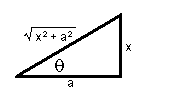
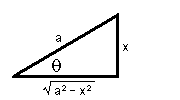
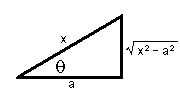
Since: `int u(x)v'(x) dx = u(x)v(x) - int u'(x)v(x) dx` Then: `int 2xln(x) dx = x^2ln(x) - int x dx = x^2ln(x) - x^2/2+C = x^2(ln(x) - 1/2)+C` Integration by trigonometric substitution. This method is particularly effective whenever the integrand involves right triangle math. Let's examine the three special right triangles shown below:
The following trigonometric identities are helpful when making trigonometric substitutions:
Example 5: Given: `int 1/sqrt(16-x^2) dx ` Let: `x=4sin(theta) dx=4cos(theta) d theta sqrt(16-x^2)=4cos(theta)` Then: `int 1/sqrt(16-x^2) dx = int (4cos(theta) d theta)/(4cos(theta)) = int d theta = theta = sin^(-1)(x/4)+C` Example 6: Given: `int x/sqrt(x^2-4) dx ` Let: `x=2sec(theta) dx=2sec(theta)tan(theta) d theta sqrt(x^2-4)=2tan(theta)` Then: `int x/sqrt(x^2-4) dx = int (4sec^2(theta)tan(theta) d theta)/(2tan(theta)) = int 2sec^2(theta) d theta = 2tan(theta) = sqrt(x^2-4)+C` Integration of rational functions. This method is helpful when you have one polynomial divided by another polynomial, a rational function. The key to this method is the decomposition of the rational function into partial fractions. In cases where the numerator is of a degree larger than the denominator you must first use long divison or synthetic division to produce an expression plus a rational function. The remaining rational function is then decomposed into partial fractions. Once the rational function has been simplified, you should find integration of the individual parts easily. Example 7: Given: `int (5x+7)/(x^2+3x+2) dx ` Let: `(5x+7)/(x^2+3x+2) = A/(x+2)+B/(x+1) => A(x+1)+B(x+2) = 5x+7` Set: `x=-2 = A((-2)+1) = 5(-2)+7 => -A = -3 => A = 3` Set: `x=-1 = B((-1)+2) = 5(-1)+7 => B = 2` Then: `int (5x+7)/(x^2+3x+2) dx = int 3/(x+1)+2/(x+2) dx = 3ln(x+1)+2ln(x+2)+C` Example 8: Given: `int (x^3+5)/(x^2-2x+1) dx ` Since the degree of the numerator is greater than the degree of the denominator, use long division to reduce the integrand: `(x^3+5)/(x^2-2x-3) = x+2+(7x+11)/(x^2-2x+1)` Decompose the fractional part of the reduced integrand into partial fractions: `(x^3+5)/(x^2-2x-3) = x+2+(7x+11)/(x^2-2x+1) = x+2+8/(x-3)-1/(x+1)` Then: `int (x^3+5)/(x^2-2x+1) dx = int x+2+8/(x-3)-1/(x+1) dx = x^2/2+2x+8ln(x-3)-ln(x+1)+C` Hopefully, you will find these four techniques helpful when working with more advanced integrands. |