The inputs above will be hidden when the program finally gets launched. Currently, I am not hiding them even when you close the calculator. The purpose of the inputs is to help in debugging. This allows you to enter simple code on the calculator screen but the program translates the input to javascript math. Give it a try and see if you notice any obvious problems or have suggestions for improvements.
The javascript math object methods used for this calculator are not accurate for very large or very small numbers. In particular, the trigonometric functions may yield very small answers that should actually be zero or very large answers that should be infinite. This typically occurs at 90° or pi/2 intervals.
DO NOT USE WHERE HIGH PRECISION IS REQUIRED. USE AT YOUR OWN RISK.
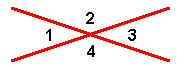
Vertical angles are the angles that are formed opposite each other when two lines intersect. The easiest way to remember the relationship of the angles formed by two intersecting lines is to draw two lines so that it is very obvious that one pair of angles is much larger than the other pair, such as is shown below:
From this drawing it is very easy to see that the little angles have equal measure and the large angles have equal measure. In this illustration, the odd angles, 1 and 3 are equal and the even angles, 2 and 4 are equal.
It should also be noted that any two adjacent angles are supplementory, forming a straight line yielding a measure of 180°.
∠1 + ∠2 = ∠1 + ∠4 = ∠2 + ∠3 = ∠3 + ∠4 = 180°
Sometimes you will be presented with angles that include a variable and you have to solve for the variable. Simply determine whether the angles are equal or supplementary, and solve the resulting equation for the unknown.